Financial Education for Kids: Raising Money-Smart Children
In a world where financial literacy is rarely taught in schools, parents play a crucial role in preparing children for financial success. While childr...
In a world where financial literacy is rarely taught in schools, parents play a crucial role in preparing children for financial success. While children learn academic subjects like maths and science in structured environments, financial knowledge is often left to chance. Unfortunately, this means many young adults enter the workforce or higher education without a clear understanding of how to budget, save, borrow responsibly, or build wealth.
Teaching children about money doesn’t have to be complicated or overwhelming. In fact, when taught in small, age-appropriate steps, money lessons can become a natural part of daily life. By equipping children with financial knowledge early, parents create a foundation for lifelong financial well-being and help break generational cycles of money mismanagement.
Why Early Financial Education Matters
Research shows that money habits and attitudes can form as early as age seven. This means that children are already learning about money—through observation and experience—long before parents may consciously begin teaching them. Whether they overhear conversations about bills, see a parent using a debit card, or watch adverts encouraging spending, kids absorb these experiences like sponges.
Early financial education offers numerous benefits:
Practical math skills: Money management reinforces mathematical concepts like addition, subtraction, and percentages in real-world settings. Counting coins or calculating discounts helps children see maths as useful and practical.
Delayed gratification: Learning to save for goals—whether it’s a toy, bike, or event—teaches patience and the importance of waiting for something worthwhile.
Confidence with money: Familiarity with financial concepts reduces anxiety about money in adulthood. Children who understand budgeting and saving grow into adults who feel more in control of their finances.
Critical thinking: Evaluating purchases and making trade-offs (buying one item instead of another) develops decision-making skills applicable to many areas of life.
Values and responsibility: Money conversations can introduce values such as generosity, sustainability, and prioritising needs over wants.
By treating money as a skill to be learned, parents empower children to make informed financial decisions that will shape their futures.
Age-Appropriate Financial Lessons
Children process and understand financial concepts differently depending on their stage of development. Parents can gradually build lessons over time to match their child’s maturity.
Ages 3–5: Money Awareness
At this age, children are just beginning to understand the world of money.
Introduce coins and bills by name, size, and colour. Playing simple matching games can help them recognise denominations.
Play store with toy money and everyday household items. Roleplay teaches that money is exchanged for goods and services.
Distinguish between needs (food, clothing, shelter) and wants (toys, treats) through short conversations during shopping trips.
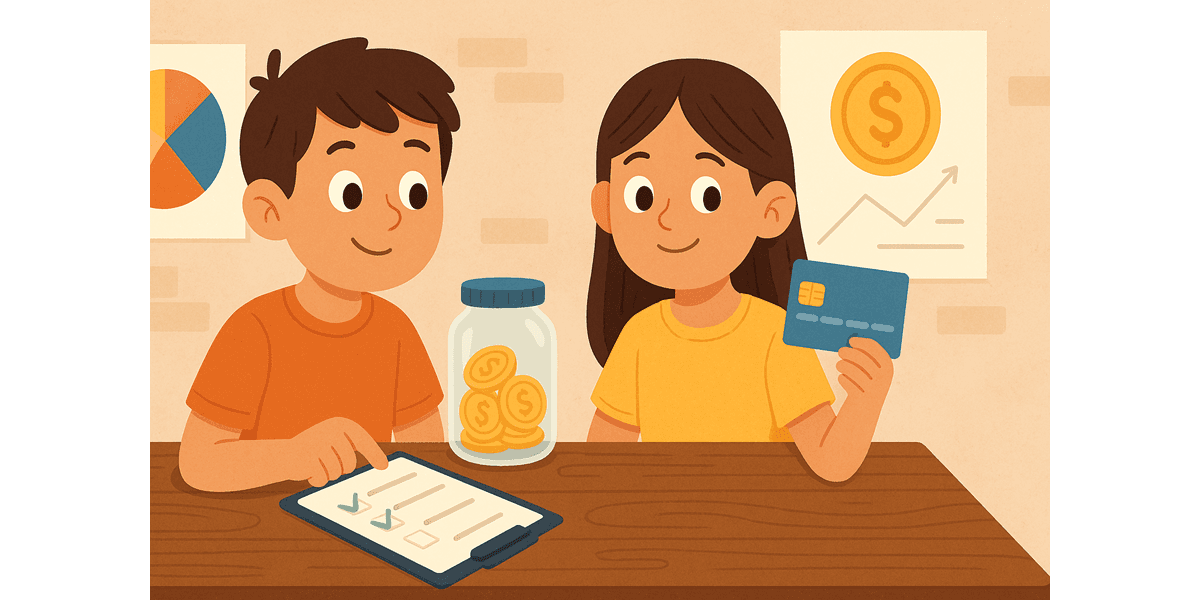
Use clear jars for saving, spending, and giving. Seeing money accumulate reinforces that saving requires time and effort.
Ages 6–10: Money Management Basics
This is the stage when children begin handling money with more independence.
Introduce a three-jar system: save, spend, and give. This builds balance between short-term fun, long-term goals, and generosity.
Provide opportunities to earn money through age-appropriate chores. Payment teaches that money comes from effort.
Help set and save for small goals, such as a new toy or trip to the cinema, showing how small contributions add up.
Involve children in some family shopping decisions. For example, let them compare the cost of two cereal boxes and decide which is the better value.
Ages 11–13: Financial Planning
Pre-teens are ready for more complex concepts.
Open a savings account and explain how interest works, even if it’s minimal. Watching their money grow helps reinforce delayed gratification.
Introduce the concept of a budget. Show them how to allocate their pocket money into different categories.
Discuss advertising tactics. Teach kids to question whether they truly need what ads promise.
Allow increasing decision-making power. For example, let them manage part of their birthday or holiday money on their own.
Ages 14–18: Advanced Skills
Teenagers are close to entering the adult world, so this is a crucial stage.
Encourage earning through part-time jobs or entrepreneurship, like babysitting, mowing lawns, or online gigs.
Teach comparison shopping: how to evaluate brands, read reviews, and look for discounts.
Introduce credit concepts and how borrowing works. Explain interest rates, minimum payments, and the risks of debt.
Discuss college costs and financing options. Involve teens in conversations about student loans, grants, and scholarships.
Involve them in family financial discussions, such as how you set budgets for holidays or monthly expenses, so they see real-world application.
Making Financial Education Engaging
Children learn best when the lessons are practical, fun, and relevant. Here are ways to keep money education engaging:
Use everyday moments: Grocery shopping, paying bills, or filling up the car provide natural opportunities for money lessons. For instance, comparing prices per unit in the supermarket is an excellent real-life maths and budgeting exercise.
Share age-appropriate information: Discuss family financial decisions without overwhelming them. For example, explain why you chose one phone plan over another because it offered better value.
Leverage technology: There are many kid-friendly apps and online games that simulate earning, saving, and spending in fun, interactive ways.
Celebrate successes: Praise children when they make wise money choices. Positive reinforcement builds lasting confidence.
Encourage generosity: Have children choose a charity to donate to or participate in giving drives. This builds empathy and shows money’s role beyond personal use.
Common Challenges and How to Overcome Them
Parents may encounter obstacles when teaching kids about money:
“I don’t know enough myself.” You don’t have to be a financial expert to teach kids the basics. Learning alongside them can be powerful, as it shows that money is a lifelong journey.
“I don’t want them to worry about money.” Teaching financial concepts doesn’t have to involve sharing every family struggle. Instead, frame conversations positively: focus on planning, choices, and opportunities.
“They’re not interested.” Kids may resist lessons if they feel forced. Connect money lessons to their interests: saving for a new video game, budgeting for a concert, or earning money for sports equipment.
Final Thoughts
Financial education is one of the most valuable gifts parents can give their children. By providing age-appropriate lessons and modeling healthy financial behaviors, you equip the next generation with skills that contribute to lifelong financial confidence and success.
Money doesn’t have to be a taboo subject. In fact, when families speak openly and positively about financial goals, challenges, and choices, children grow up viewing money as a tool rather than a source of stress.
Starting early, keeping it simple, and reinforcing lessons over time ensures children will not only know how to manage money but also how to use it to create a meaningful and secure life.