🛠️Using Credit Offers and Loans Without Hurting Your Score🧩
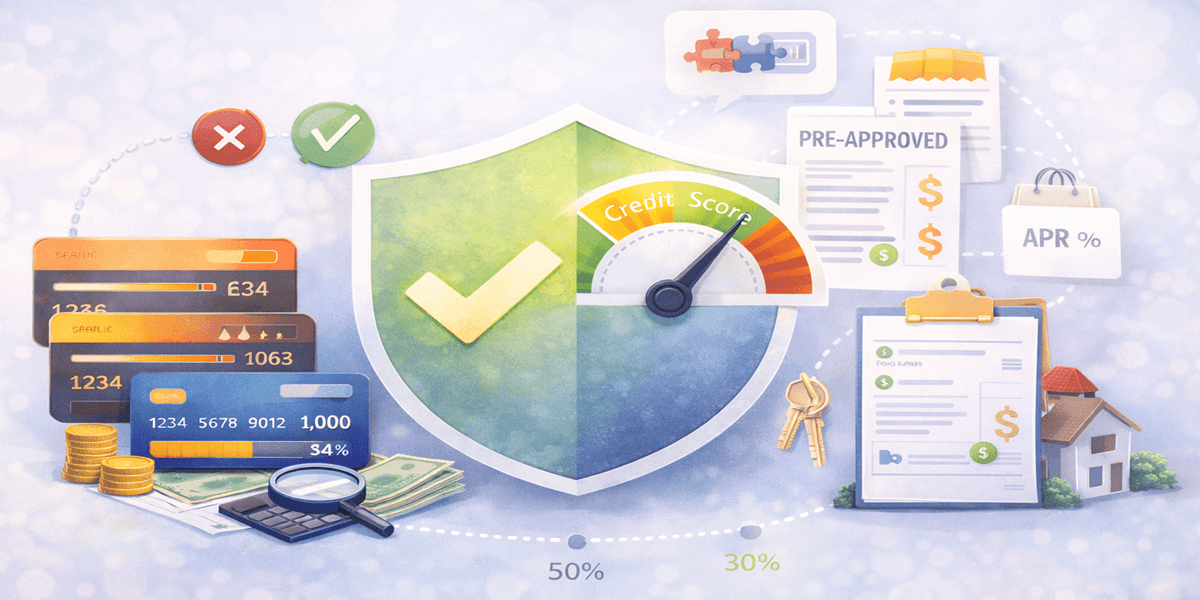
Credit offers are everywhere. Pre-approved cards. Balance transfer promotions. Loan comparisons promising fast decisions and lower payments.
It’s easy to assume that these offers are either dangerous or helpful — but in reality, neither is true on its own.
Credit offers aren’t inherently bad. Misaligned use is the real risk.
When credit tools are used at the wrong time, in the wrong order, or without context, they can quietly undermine progress.
When they’re used deliberately — with timing, readiness, and structure — they can support stability and flexibility.
This article explains how to evaluate credit offers and loans without damaging your credit, and how to use comparison and decision tools to stay in control.
🧠 Why Credit Tools Get a Bad Reputation
Many people associate new credit with negative outcomes because they’ve experienced:
Sudden score drops after applications
Higher balances after consolidation
Offers that looked “guaranteed” but weren’t
Temporary relief followed by long-term stress
These outcomes are rarely caused by the product itself. They’re usually caused by timing mismatch.
Credit tools amplify whatever system they’re placed into. If the underlying home economy is unstable, credit magnifies that instability. If the system is aligned, credit can smooth cash flow and reduce pressure.
🔍Soft Checks vs❗Hard Checks (Why the Difference Matters)
One of the most important distinctions in credit decision-making is understanding how an inquiry is recorded.
🔍 Soft Credit Checks
Soft checks are used for:
Credit monitoring
Loan and card comparisons
Pre-qualification tools
Some credit limit reviews
Key characteristics
Do not impact your credit score
Are not visible to lenders reviewing applications
Can be used freely for research and planning
Soft checks are designed for exploration without consequence.
❗ Hard Credit Checks
Hard checks occur when you:
Submit a formal application
Accept a credit offer
Finalize a loan or card request
Key characteristics
Are visible to lenders
May cause a small, temporary score dip
Signal active credit-seeking behavior
Hard checks aren’t harmful by default — but unnecessary ones add friction without benefit.
🧠 Why This Distinction Protects You
Households that rely on soft-check tools first:
Compare options without pressure
Avoid speculative applications
Apply only when outcomes are likely
This shifts credit use from reactive to intentional.
🧩 Compare Credit Options With No Impact
🔔The Truth About “Pre-Approved” Offers
“Pre-approved” is one of the most misunderstood phrases in consumer credit.
What pre-approval usually means:
Initial screening criteria were met
Some risk factors appear acceptable
A formal application has not yet occurred
What it does not mean:
Guaranteed approval
Fixed terms
No additional review
Pre-approval is best understood as an invitation to apply, not a promise.
🧠 Why This Matters for Credit Health
Treating pre-approvals as guarantees leads to:
Multiple applications
Stacked hard inquiries
Increased perceived risk
Treating them as signals allows households to:
Pause and evaluate readiness
Compare multiple offers via soft checks
Apply once, strategically
🧩 Review Pre-Qualified Offers Carefully
🔁 When Consolidation Can Help — and When It Doesn’t
Debt consolidation is often marketed as a cure-all. In reality, it’s a tool that works only under specific conditions.
Consolidation tends to help when:
Spending habits are already controlled
Existing balances are not growing
Payments fit comfortably within cash flow
Old accounts are not immediately reused
In these cases, consolidation can:
Simplify payments
Reduce interest pressure
Improve visibility
Consolidation often backfires when:
Credit cards remain active and are reused
Consolidation lowers payments but extends debt life
Cash flow is still unstable
The underlying cause of balances isn’t addressed
This is why consolidation should be evaluated as part of the home economy system, not as a standalone fix.
🧮 Tools That Support Smarter Consolidation Decisions
Before consolidating, households benefit from:
Payment comparison tools
Cash-flow fit calculators
Utilization impact previews
These tools help answer:
Will this actually reduce pressure?
Does this improve monthly flexibility?
What happens if income fluctuates?
🧩 Check Whether Consolidation Fits Your Budget
📊 How New Credit Affects Utilization and Risk Signals
New credit can improve or worsen utilization — depending on how it’s used.
Potential benefits:
Higher total available credit
Lower overall utilization (if balances stay flat)
Increased flexibility
Potential risks:
Immediate balance transfers raise utilization
New accounts reduce average age
Rapid balance growth raises red flags
This is why timing matters.
Applying for credit while utilization is already high often compounds risk. Waiting until utilization is stable creates better outcomes.
🧩 Preview How New Credit Could Affect Utilization
🛍️ Rate Shopping Windows (How to Shop Without Damage)
Credit scoring models recognize that consumers shop for certain types of loans.
Rate shopping is expected for:
🚗 Auto loans
🏠 Mortgages
🎓 Student loans
Multiple inquiries for the same loan type, within a short window, are often treated as a single inquiry.
How to shop safely:
Do research first with soft-check tools
Narrow choices before applying
Submit applications within a focused time frame
Avoid mixing loan types during the same period
This approach allows comparison without unnecessary penalties.
🧩Compare Loan Rates the Smart Way
⚠️ Common Credit Offer Mistakes to Avoid
Even well-intentioned consumers fall into predictable traps.
❌ Applying “just to see”
Curiosity applications add friction without value.
❌ Stacking multiple offers
More offers ≠ better outcomes.
❌ Using credit to solve timing problems
This usually signals a cash-flow issue, not a credit issue.
❌ Ignoring the impact on utilization
New balances matter immediately.
Avoiding these mistakes is often more powerful than finding the “perfect” product.
🏠 Credit Offers Inside the Home Economy
Credit tools interact with:
Payment timing
Cash-flow stability
Utilization thresholds
Monitoring and alerts
When these systems are aligned:
Credit becomes a support tool
Stress decreases
Decisions feel measured
Outcomes stabilize
When they’re misaligned, even good products create friction.
🔁 A Simple Readiness Check Before Applying
Before accepting or applying for any credit offer, pause and ask:
Is utilization currently stable?
Does this improve monthly flexibility?
Am I using soft-check tools first?
Is the timing intentional?
If the answer to most is “yes,” the risk is usually lower.
✅ Key Takeaway
Credit offers and loans aren’t dangerous — misaligned timing and readiness are.
The goal isn’t to avoid credit. It’s to use it deliberately, with:
Visibility
Comparison tools
Cash-flow awareness
Utilization control
When credit tools are used at the right moment, they support stability instead of undermining it.